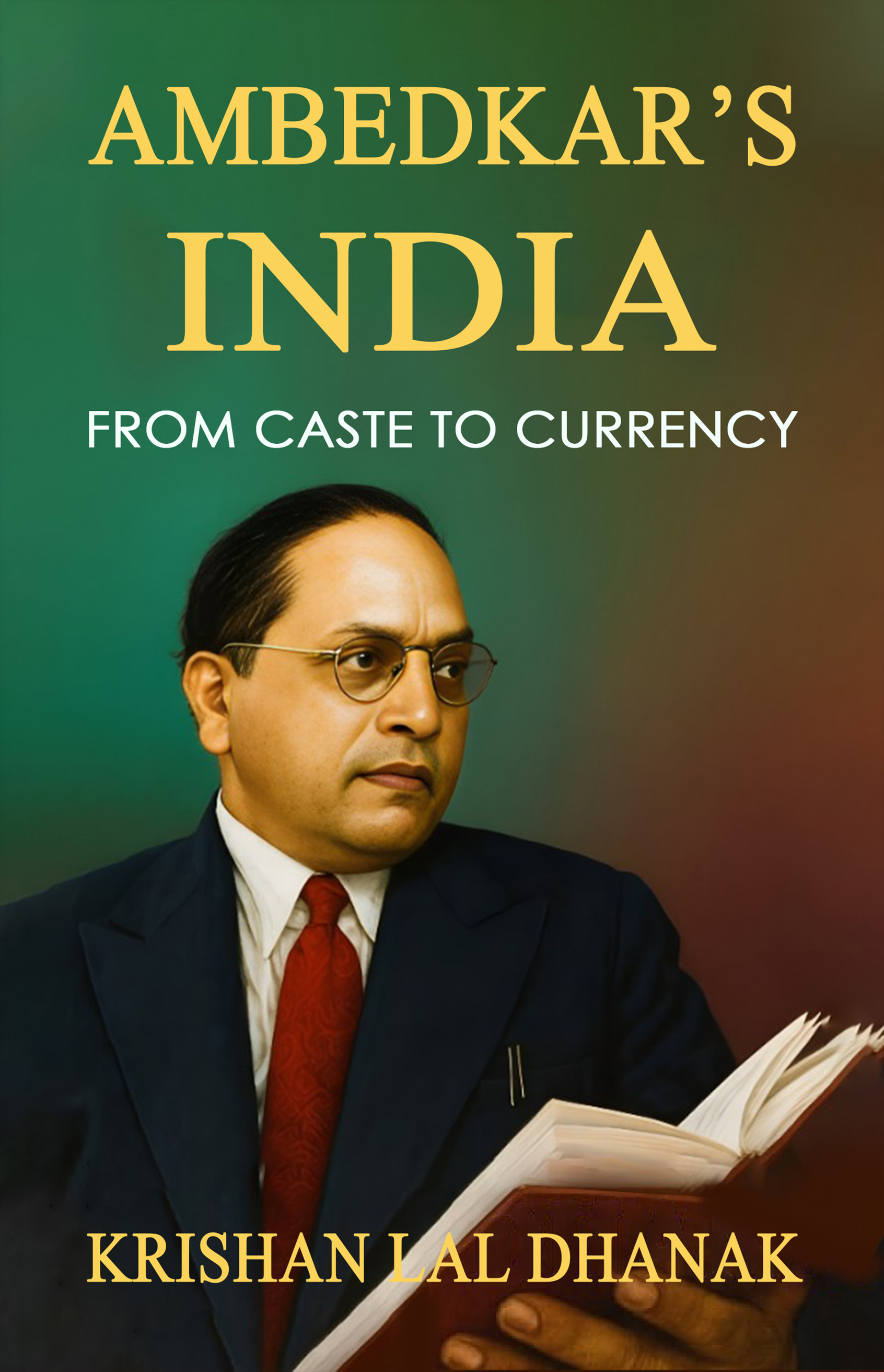
The journey of Dr. B.R. Ambedkar, one of India's most influential leaders, is a powerful narrative of struggle, transformation, and hope. Ambedkar’s India: From Caste to Currency seeks to unravel this extraordinary journey, capturing not only his tireless fight against the oppressive caste system but also his forward-thinking vision for India’s economic future. This book attempts to highlight the profound impact Ambedkar's ideas have had in shaping modern India, offering a comprehensive view of how his ideologies evolved from the fight for social justice to pioneering concepts of economic reform.
Dr. Ambedkar is widely recognized for his role in drafting the Indian Constitution and for being a champion of the rights of Dalits, women, and marginalized communities. However, beyond his political leadership, he was also a pioneering economist and social reformer whose vision transcended the boundaries of mere social equality. He understood that true emancipation would only be possible when the oppressed had not only political and social rights but also access to economic resources, equality of opportunity, and a rightful share in the nation’s prosperity.
This book explores the intersection of Ambedkar’s struggle against caste and his comprehensive views on economic structures, currency, and wealth distribution. Tracing the latter part of his life and his economic writings, Ambedkar’s India: From Caste to Currency reflects on how he linked social justice with economic equality. It offers a vision of a reformed society where all citizens, irrespective of caste, could actively participate in national development. Ambedkar was among the first to recognize the intimate relationship between caste and economic exploitation. His critiques of India’s social and economic systems formed the basis of his proposals for inclusive growth, with special emphasis on creating opportunities for the marginalized. His advocacy of land reforms, equitable distribution of wealth, and state-led development was not merely theoretical but a call to action-aimed at building a just and dignified society.
As we move from Ambedkar’s social ideals to his economic insights, we see how he imagined an India that was not only free from social injustice but also economically empowered. His revolutionary ideas about money, finance, and redistribution were deeply intertwined with his broader vision of liberty, equality, and fraternity. This work is both an intellectual homage to Ambedkar’s life and an invitation for readers to engage with the contemporary relevance of his thought. The concepts he championed remain as vital today as they were in the mid-20th century.
Through analysis and contextual reflection, this book seeks to illuminate how Ambedkar’s ideas continue to shape debates on social justice, economic inequality, and India’s democratic future. Reflecting on the interconnection of caste and currency, the book provides a holistic perspective on Ambedkar's contributions and underscores the urgency of his vision for a just and inclusive India. It stands as a tribute to a man whose thoughts and actions have inspired generations of reformers, thinkers, and leaders, and whose legacy continues to shape the moral and economic fabric of the nation.
Alongside his political and social struggles, Dr. B.R. Ambedkar’s intellectual journey found expression in a series of groundbreaking writings and speeches that shaped India’s discourse on caste, democracy, and equality. In 1920, he launched Mook Nayak (“The Leader of the Voiceless”), a journal that gave the oppressed classes a powerful platform to articulate their concerns and challenge upper-caste dominance. In 1927, his fiery address during the Mahad Satyagraha became a historic turning point, as he asserted Dalits’ right to public resources and symbolically rejected the Manusmriti-the text embodying caste oppression. His most radical work, Annihilation of Caste (1936), originally written as a lecture, remains one of the most uncompromising critiques of the Hindu social order.
As the independence movement progressed, Ambedkar articulated a framework for social and economic justice in States and Minorities (1947), a memorandum submitted to the Constituent Assembly, in which he demanded constitutional safeguards, state ownership of key industries, and protection of fundamental rights for marginalized groups. His intellectual journey culminated in the spiritual and philosophical domain with The Buddha and His Dhamma (published posthumously in 1957), which reinterpreted Buddhist teachings as a rational and egalitarian alternative to caste-based Hinduism, mirroring his own historic conversion to Buddhism in 1956.
Taken together, these works form a living timeline of Ambedkar’s evolving thought-beginning with the struggle for voice and dignity, moving through radical social critique and constitutional design, and culminating in a spiritual-philosophical vision for human liberation. They are not just historical documents but enduring texts that continue to inspire movements for equality, social justice, and democracy in the 21st century.



 Continue With Google